Context: I was recently asked by a very close friend, colleague, and mentor about Shoulder Stability; he is a high school coach (with no full-time S&C coach on staff) who was looking for a bit of insight on the topic of “shoulder stability” so that he can best support his players in their training.
After wrestling with the topic for a while, trying to determine the best way to make it impactful for him and his athletes, I finally decided to do a write up that eventially became this post.
***
Shoulder stability: it can mean a lot of different things to various people, as it is often a blanketly thrown about term — think about the term “truck“. Most would consider a truck the kind of vehicle that has a cab and a bed for storing/transporting things. However, many folks will call their SUV a truck; then there are fire trucks, dump trucks, etc… We end up with just enough ambiguity that the term truck — or in our case, shoulder stability — can then carry varying shades of meaning in between its anatomical definition and each of its contextual applications.
So, here today I will be sharing what our truck — shoulder stability — means by definition, and then adjacently, what it means to me in a general, practical application.
By most definitions, shoulder stability refers to the ability of a person to center the ‘ball’ in the ‘socket’ of the shoulder. From an active and voluntary standpoint, that centration comes from the muscles around the shoulder — predominantly the rotator cuff.
If you are familiar with one of the most influential strength and conditioning coaches in the history of our field, Mike Boyle, then you might have heard of his “Joint-by-Joint” approach, whereby he classifies the major joints of the body (or groupings of joints) by their nature of being either mobile or stable. In theory…
- Your ankles should be mobile,
- Knees should be stable,
- Hips should be mobile,
- Lumbar spine should be stable,
- Etc…
Notice that each joint is adjacent to another of the opposite category – stable on top of mobile on top of stable… Due to is vast degrees of freedom, the shoulder (glenohumeral joint) naturally leans toward being a mobile joint.
But, with great mobility comes the needto ensure stability. The shoulder is often likened to a golf ball on a tee. In that way, the ball on the tee is great for hitting a long drive, but it is mightily susceptible to getting knocked off the tee by wind. And that is where training for shoulder stability is often cited as a component of a well-rounded training program, and why so many folks prescribe copious amounts of rotator cuff work with bands — to strengthen the rotator cuff muscles to keep the ball on the tee.
However, it is important to be mindful of the complexity of movement at the shoulder. The ball and socket (glenohumeral joint) is just one of four joints that directly contribute to movement at the shoulder.
- Glenohumeral Joint: the ball/head of the humerus interacting with the fossa/cup of the shoulder blade/scapula
- Acromioclavicular (AC) Joint: the clavicle interacting with the acromion of the scapula
- Sternoclavicular Joint: the clavicle interacting with the sternum
- Scapulothoracic Joint: the scapula interacting with the thoracic region

Thus, it is the interplay between these four joints that contribute to total shoulder motion, not to mention how each of them then interact with the structures around them. For example, the Scapulothoracic joint speaks to the scap’s movement on the rib cage; rib cage positioning and movement, then, can certainly influence how the scapula moves, which then impacts what the humerus can do.
Try it for yourself. Let’s stand up and lock your right scapula “down and back”, and then attempt to lift your right arm straight up over your head without “unlocking” your scapula. If the scap does not move, the humerus is functionally impaired, and in a major way.
So, with all of the anatomy out of the way, let’s get to my much looser outlook on shoulder stability (pun intended):
Disclaimer: this is just one fellow’s take, and (for the purposes of broad stroke application) a very, very general one at that. You are welcome to disagree, interpret differently, or apply your knowledge in a much deeper sense. That is the art of the science in sports performance.
To me, shoulder stability is clean, usable, and healthy movement of the shoulder and its joints.
- Not strength
- Not mobility for mobility’s sake
- Not “down and back”
Clean, usable, healthy movement of the shoulder joints.
To harken back to our truck termanalogy… a truck to me is a vehicle used to get the job done right, whether it has a bed, or a ladder, or a topper. Similarly, to me, shoulder stability is clean, healthy, and usable movement of the upper extremity, no matter how we get there.
So, how do we train it? Unfortunately, it is too broad of a topic to cover in a blog post, but here are some programmatic considerations I would make in a very broad brush strokes way — the kind of way when you are having to train multiple athletes on your own under non-ideal circumstances and you just need to know some themes to embed into your program to make sure you are at least mindful of shoulder health.
I. Considering Compensations
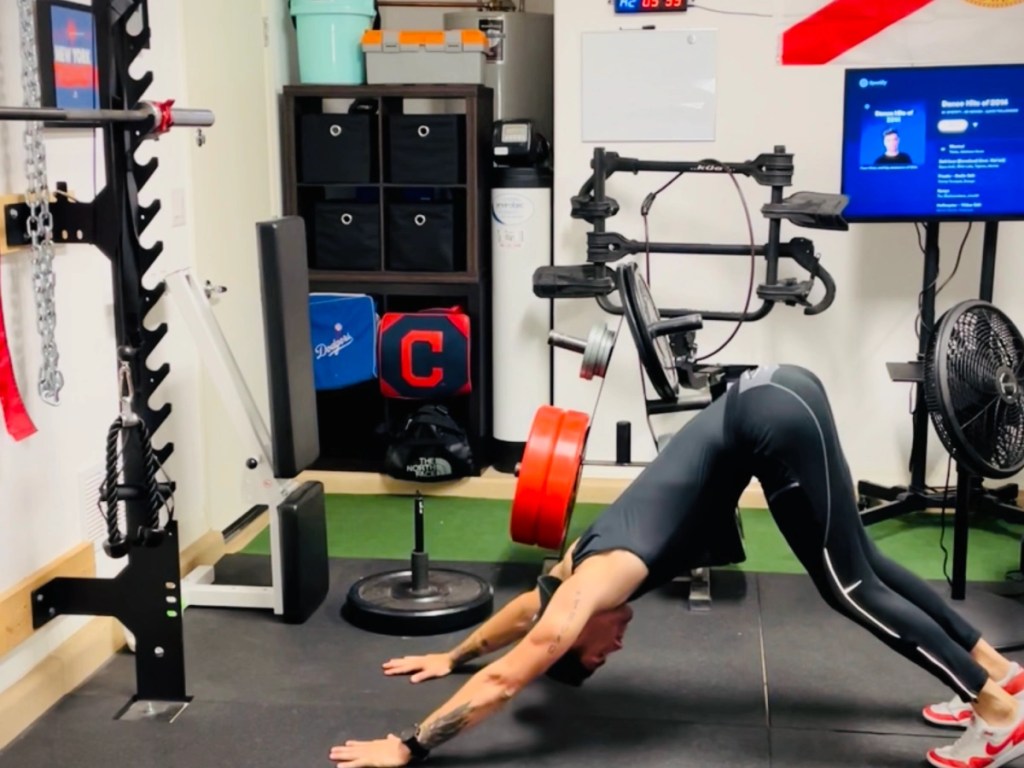
As discussed earlier, the shoulder itself is impacted by all of the joints upstream (or proximal) of it. Thus, movement at the shoulder can be hindered or even enhanced (seemingly) by positioning at other joints. For example, if you stand up tall and try to raise your arms over your head, eventually you will run out of room or ability to go any higher. But, if you arch your lower back and let your rib cage flair up nice and high, all of the sudden you might notice your arms are (seemingly) going further overhead.
I say seemingly, because you are likely not getting any additional movement at the shoulder in this scenario, but instead are compensating upstream (lumbar extension) to get the downstream motion that is lacking (shoulder flexion). Thus, when training for true shoulder motion, we want to do so without compensating; sticking to the range of motion we currently have, and slowly building up our strength, stamina, and range over time in a clean, true way. Earn this shoulder “stability” the right way and it will contribute to clean, healthy, usable shoulder movement; compensate your way through your workouts and you are only boosting your training numbers and restricting overall shoulder function.This goes for any direct shoulder work, or more generally with any upper-body training.
II. Appreciate Clean Movement of the Scapula to Develop Shoulder Stability
If shoulder stability largely revolves around the centration of the ball in the socket, then it is critical to appreciate that where the ball goes, the socket ought to follow. So often when we are younger we are taught the “down and back” positioning for the scapula, but miss out on the fact that this fixes the “socket” in one place. Thus, either the ball can’t move very far, or if it does, it is likely stressing all the passive structures within the shoulder (capsule, ligaments, etc).
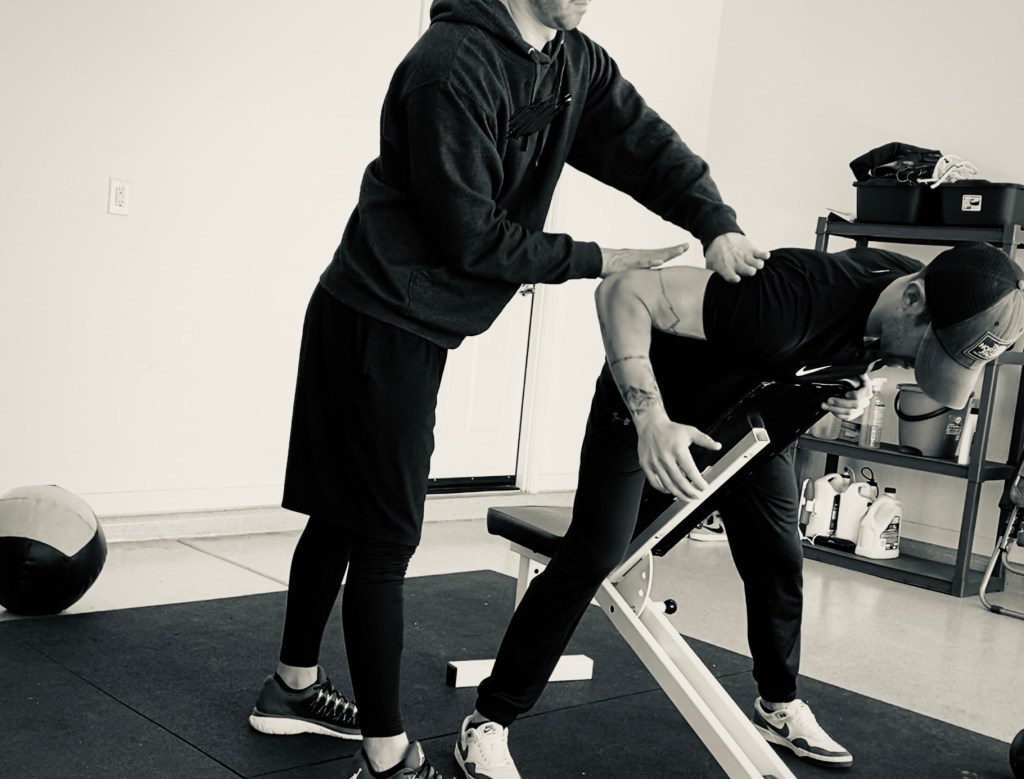
Take, for example, dumbbell rows: When bent over performing this exercise, some folks might only allow the weight to be lowered by the humerus (arm), while keeping the scaps relatively fixed. Meanwhile, you might have a 70+ lbs dumbbell actively trying to pull the ball out of the socket. While this provides one type of training effect (you are, in fact, still training the shoulder to resist distraction forces), a more applicable one to athletes who need a strong, stable shoulder in all kinds of range of motion (e.g. a pitcher releases the ball way out front where the scapula definitely is not down and back) would be to allow the weight to be lowered further such that the scapula moves out and around the rib cage. Likewise, when doing, say, Landmine Presses or Push-Ups, we could probably perform more reps of lift heavier loads if we limit scapular motion, however protraction (spreading) and/or upward rotation are key parts of shoulder movement during activities like throwing. Thus, we are better served to “reach” the bar on Landmine Presses or push the floor as far away as possible in the Push-Up in order to train the shoulder through a more full, usable range of motion.
III. A Breadth of Training Methods
Okay, so this is where every coach will have their own opinion and expertise (or tool-box) to pull from. But, I think the theme is what is most important here:
Clean, healthy, usable (and sport-specific) motion at the shoulder likely does not come from just one or two types of training modalities — e.g. banded rotator cuff work and mobility drills. Rather, like any other aspect of training (say, training the lower-body for sprint performance), it will take a confluence of methods that are targeted toward the needs of the sport and athlete.
In the case of the throwers shoulder, here are some things we can reason from the sport:
- The muscles responsible for shoulder stability rarely work concentrically. They often must exert high and rapid forces in an eccentric manner to decelerate the arms toward the end of the throwing motion
- The shoulder must be able to rotate at extreme speeds, which requires the primary internal rotators of the shoulder (e.g. Pec and Lat) to be strong and powerful
- A throwing sport like baseball often requires upwards of one thousand throws in a week, and potentially one to two hundred throws in a day. Not only does this require a great base of physical development locally (the shoulder) but also globally (the body)
- It must not be overlooked that throwing, in and of itself, trains the shoulder, and ultimately fatigues it as well. So, pouring on “shoulder stability” work on top of high throwing workloads without care may lead to deleterious outcomes long-term. For example, if you are a runner, running in and of itself is a training stimulus for your lower-body. Strength training and plyometrics would also be highly recommended for your development as a runner. However, doing all of these things all of the time is probably a recipe for disaster, if not now, then over time. Throwing can be looked at in a similar light.
So, what would this indicate for a thrower? Surely many tools could tackle this project, but some things that come to mind for me if you were looking for the “get started guide”…
- Deliberate training of the entire body, and mindfulness of posture and positioning of the rib cage and pelvis when specifically training the upper-body
- Truly strengthen the upper-body, because internal rotation (in part) is driven by some of the main muscle groups of the upper-half
- Reaching (landmine presses, push-ups, full range of motion rows) just as much as pressing (locking the scapula down, like in a bench press)
- Rotator Cuff work that goes beyond concentric band exercises (think perturbations that are more unpredictable, or manual resistance exercises that can also load the eccentric component)
- Getting the arms overhead often in training without compensating; this can be as simple as unloaded shoulder mobility (flexion) exercises early on, and progressing to overhead carries, presses, and pulls (e.g. supine shoulder flexion, waiter walks, half-kneeling KB presses, and pull-ups, respectively).
- Mindfulness of throwing workloads and how much fatigue a shoulder is already carrying when considering adding in new shoulder-specific work
 Ryan J. Faer
Leave a comment